
(Article from Ms. Nguyen Thi Huong Giang, PhD student in Sustainable Development at Vietnam National University, Hanoi)
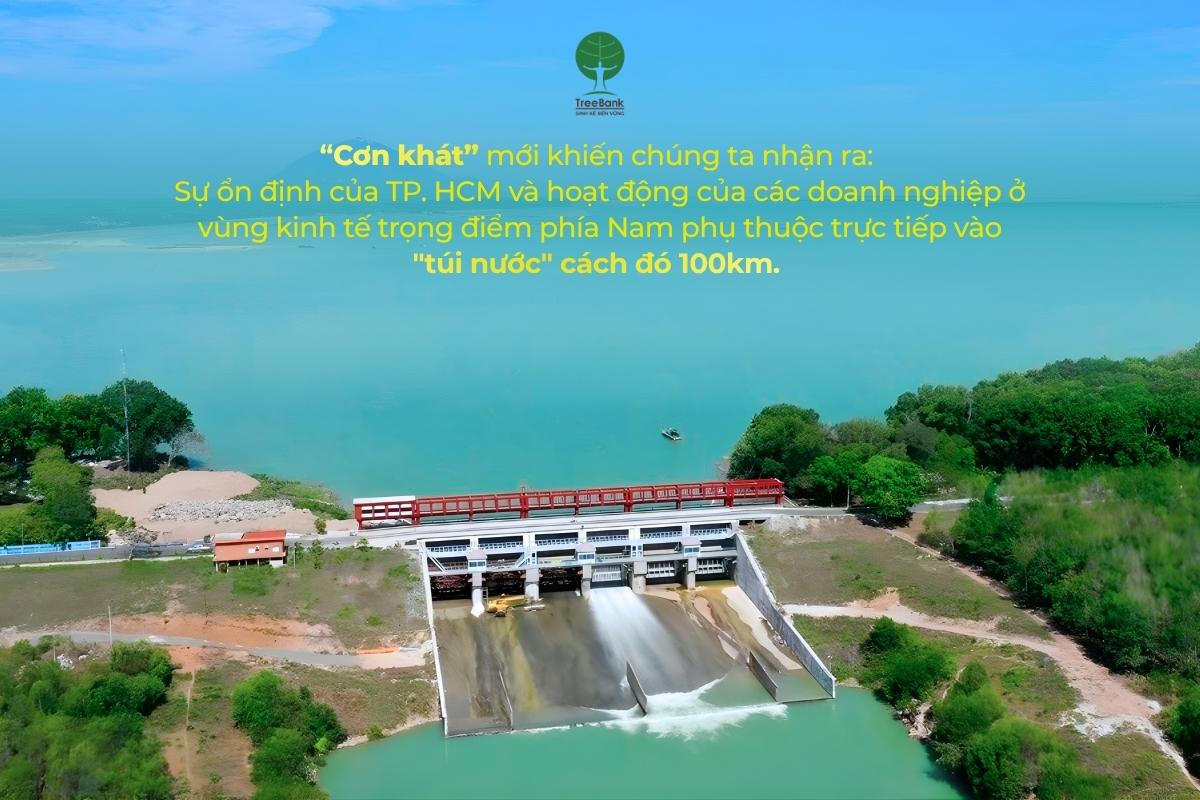
In March 2016, due to the influence of the El Nino phenomenon causing a prolonged drought, the salinity on the Saigon River at the raw water intake area of Hoa Phu pumping station exceeded the threshold allowed by the Ministry of Health. The substandard water supplied to Tan Hiep Water Plant caused the pumping station to stop operating for many hours continuously, directly threatening the domestic and production water sources of Ho Chi Minh City. The city had to "ask for help" from Dau Tieng lake to discharge salty water.
The new "thirst" makes us feel clearly: The stability of the largest urban area in the country and the operation of enterprises in the southern key economic region directly depends on the "pocket of water" 100km away. However, if we only look at Dau Tieng Lake as a pure water storage project, we are ignoring a core factor: Water is not born from the lake bed.
From irrigation works to "ecosystem assets"
In discussions of economic development, water is often seen as an "obvious input". We turn the faucet to have water, it is always ready by default, and we rarely properly value the effort behind it. But if approached from the lens of sustainable development, water is not an infinite resource. It is the result of a system of dependency where every link from land and forest to lake bed determines the sustainability of the entire economy.
With a capacity of about 1.58 billion cubic meters, Dau Tieng Lake is often seen as a technical achievement. However, if placed within the framework of the Ecosystem Services analysis of FAO and IUCN, this reservoir is actually a system that provides essential services for the Southeast region to maintain the rhythm of life and production:
If converted to economic value, this is a regional infrastructure, but currently it is not managed as an asset with risks and accompanying costs.
The real risk does not lie in the lake
A common misguided approach is to focus the whole problem on the lake itself: the capacity, the dam, the channel. According to FAO and IUCN, the operational efficiency of this "asset" depends directly on the surrounding ecosystem. And in the case of Dau Tieng Lake, that "basin" is the protective forest system around the lake – the ecological infrastructure that determines whether water will become a clean resource or become a burden to treat.
However, if we only look at the protection forest as a strip of trees on dry land, we are not fully understanding. According to international basin governance standards, a healthy protection forest system must operate as a multi-tiered ecological structure:
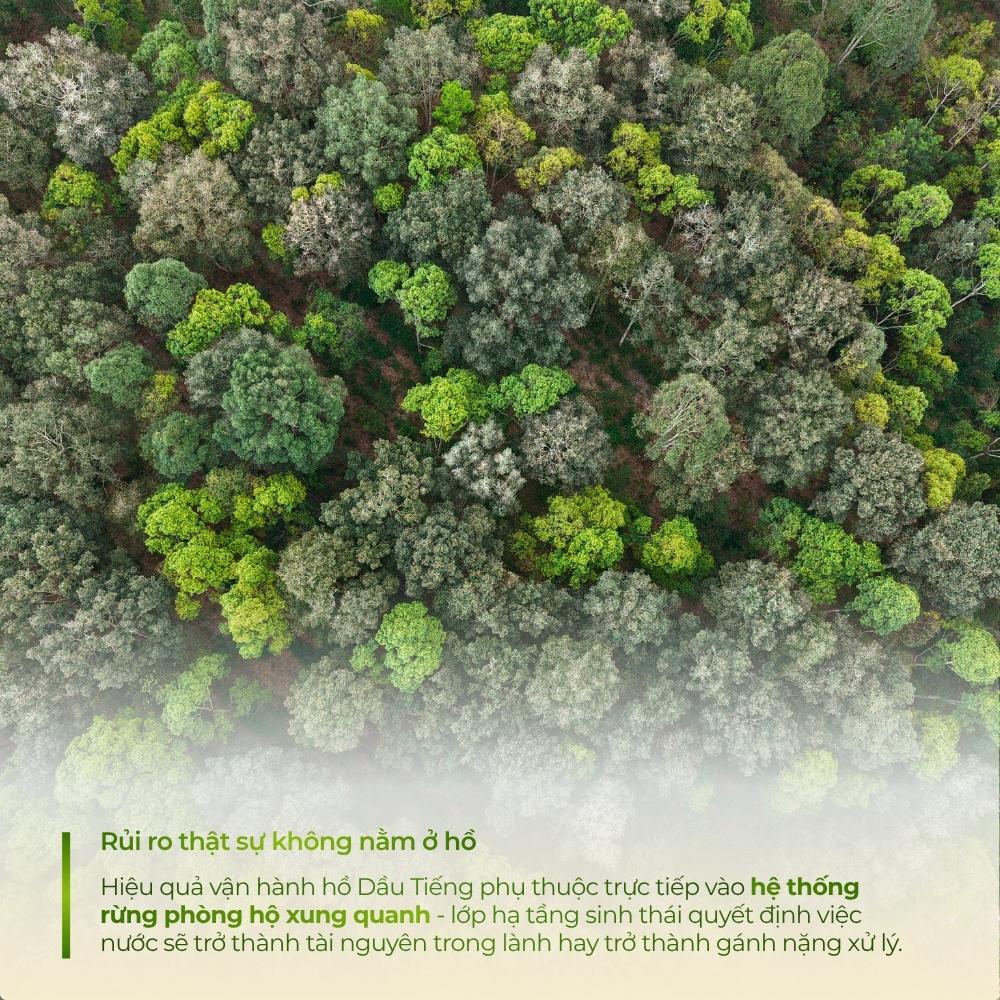
In this system, there is an area that is often overlooked but plays a particularly important role: the semi-submerged area around the lake. This is a transitional area between land and water – where water levels change with the seasons. From an ecological and hydrological perspective, the root system and vegetation here will absorb excess impurities (such as Nitrogen, Phosphorus), slowing down the flow and reducing local erosion. When the area is degraded due to bare land or uncontrolled or compacted farming, nutrients and silt go directly into the lake bed, increasing the risk of excess and algae outbreaks.
In other words, if the protection forest is the "shield", then the semi-submerged area is the "direct biofilter" of the lake. So this is the area that can make the fastest and most obvious measurable impact on water quality. If the semi-submerged ecosystem is restored and developed properly, the downstream water treatment pressure will be significantly reduced.
Signs of decline and hidden costs to the economy
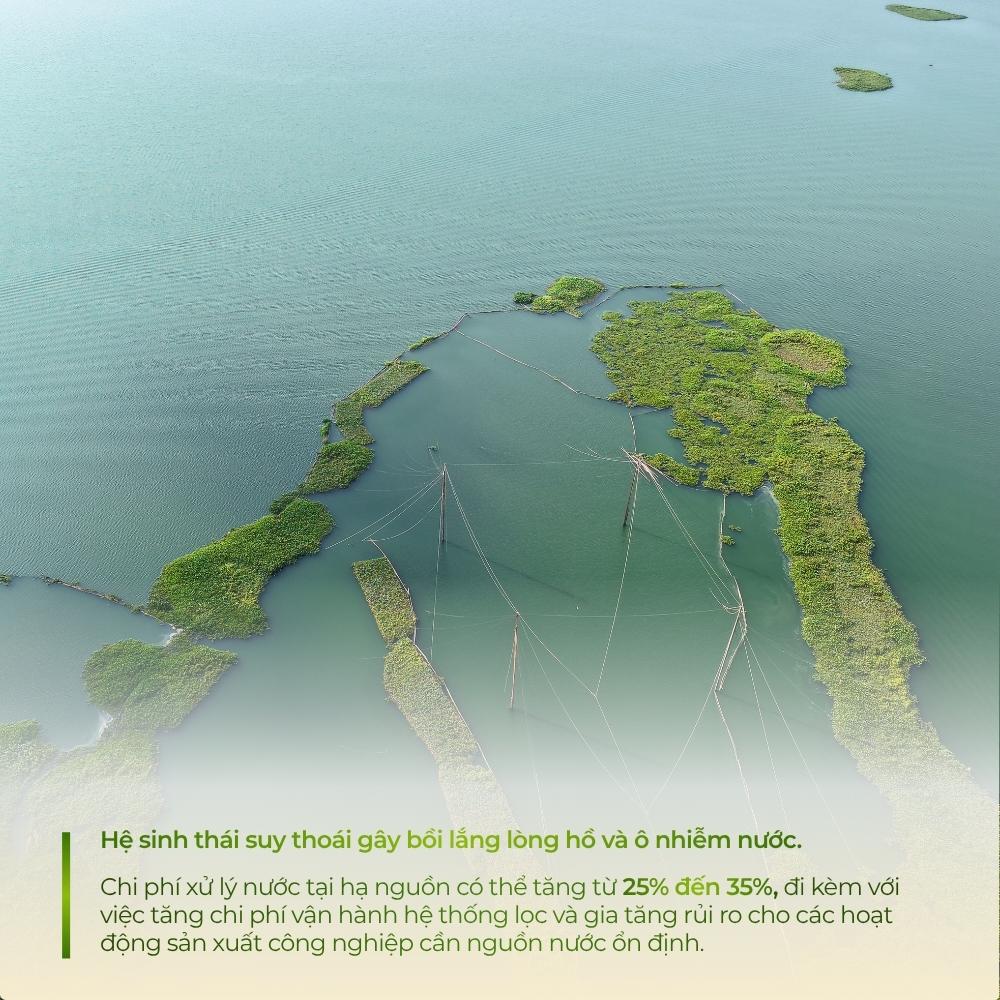
The decline of this ecological infrastructure system is no longer a theoretical assumption but has appeared measurable signals:
The economic consequences are enormous. The cost of water treatment downstream can increase by 25% to 35%, accompanied by increased costs of operating filtration systems and increased risks for industrial production activities that require a stable water source.
Redefining protection forests: from "green belt" to "infrastructure"
Thus, Dau Tieng Lake protection forest is not a passive protection layer. It is part of the infrastructure that directly determines the quantity and quality of the lake's water.
When protective forests decline, we don't just "lose trees". We are undermining the operability of the entire water system. Dau Tieng Lake does not have individual problems, but is reflecting the status of the entire basin ecosystem. Therefore, if we separate the protection forest in the management of the lake, we will only solve the top. In this context, ecosystem restoration does not stop at planting terrestrial forests, but also needs to include semi-flooded areas – where water quality is directly affected.
In other words, protection forests do not stand out, but are part of the water supply system. This is also the focus of TreeBank's current research: not "planting more trees", but restoring the hydrological function of Dau Tieng Lake protection forest.
Overcoming governance blind spots: from users to ecological infrastructure investors
In fact, water from the lake is serving as an important input for every business and home. However, the ecosystem factors that make up and maintain this water source have not yet been considered as part of the infrastructure that needs long-term management and investment.
According to the FAO and IUCN frameworks, the decline of "natural capital" always leads to an increase in operating costs and risks in the economic system. This has been observed in many basins around the world. The cost of water treatment, maintenance, and the risk of production disruption always increase as the function of the watershed ecosystem is weakened.
Instead of seeing contributing to the environment as a charitable expense, businesses should see this as an opportunity to invest in infrastructure. Joining hands with TreeBank to restore the protection forest of Dau Tieng Lake is a way for businesses to actively protect "natural capital" to ensure water security for themselves.
At TreeBank, we approach forest restoration as a multi-tiered ecological infrastructure system from watershed forests to semi-floodplains. There, all impacts on water resources are not just green sprouts planted, but sustainable economic values that can be measured and reported transparently.
———–
SERIES: SOUTHEAST LIFE CIRCUIT
Please read the next issue – Lesson 3: The TreeBank model – Turning forest restoration into infrastructure for businesses.