
In the previous two articles, we have shared the problems: Vietnam does not lack rain, but we lack the ability to retain water and Dau Tieng Lake does not operate independently but directly depends on the basin ecosystem.
From those analyses, this article will propose an approach to move from understanding to action. The question is how to restore the ecosystem does not stop at planting trees, but becomes part of the water infrastructure that can be analyzed, monitored and participated in.
MULTI-TIERED RESTORATION: INTERFERING WITH THE CORRECT OPERATING MECHANISM OF WATER
If viewed from a hydrological perspective, the problem of the basin is not in the amount of rainfall, but in the way the water moves after falling to the ground. According to FAO and IUCN basin studies, the balance between permeability and surface flow is the determinant of a system's ability to hold water.
Since then, Treebank's model does not approach according to the planting area but according to the functional layers in the water cycle.
FROM ECOLOGICAL RESTORATION TO INFRASTRUCTURE LOGIC
In resource economics, "infrastructure" is not just a physical work but any system that determines the flow of material and energy inputs. With the water system, the basin ecosystem is such a form of infrastructure. FAO and IUCN basin hydrological studies indicate that soils with forest cover have 2 to 6 times higher permeation rates than bare or compacted soils. At the same time, surface flow can be reduced by 30% to 70% depending on terrain and soil conditions.
This leads to two quantifiable consequences. The first is to reduce the peak of runoff after rain, which helps reduce erosion and sediment transport. The second is to increase the amount of water stored in the soil to maintain the background flow during the dry season. From a systems perspective, investing in ecosystems is investing in regulating the allocation of water flows in the watershed. The difference from technical works is that this is a form of distributed infrastructure, which is continuous and accumulates by area.
FIELD ACCUMULATION IS THE FOUNDATION OF THE MODEL
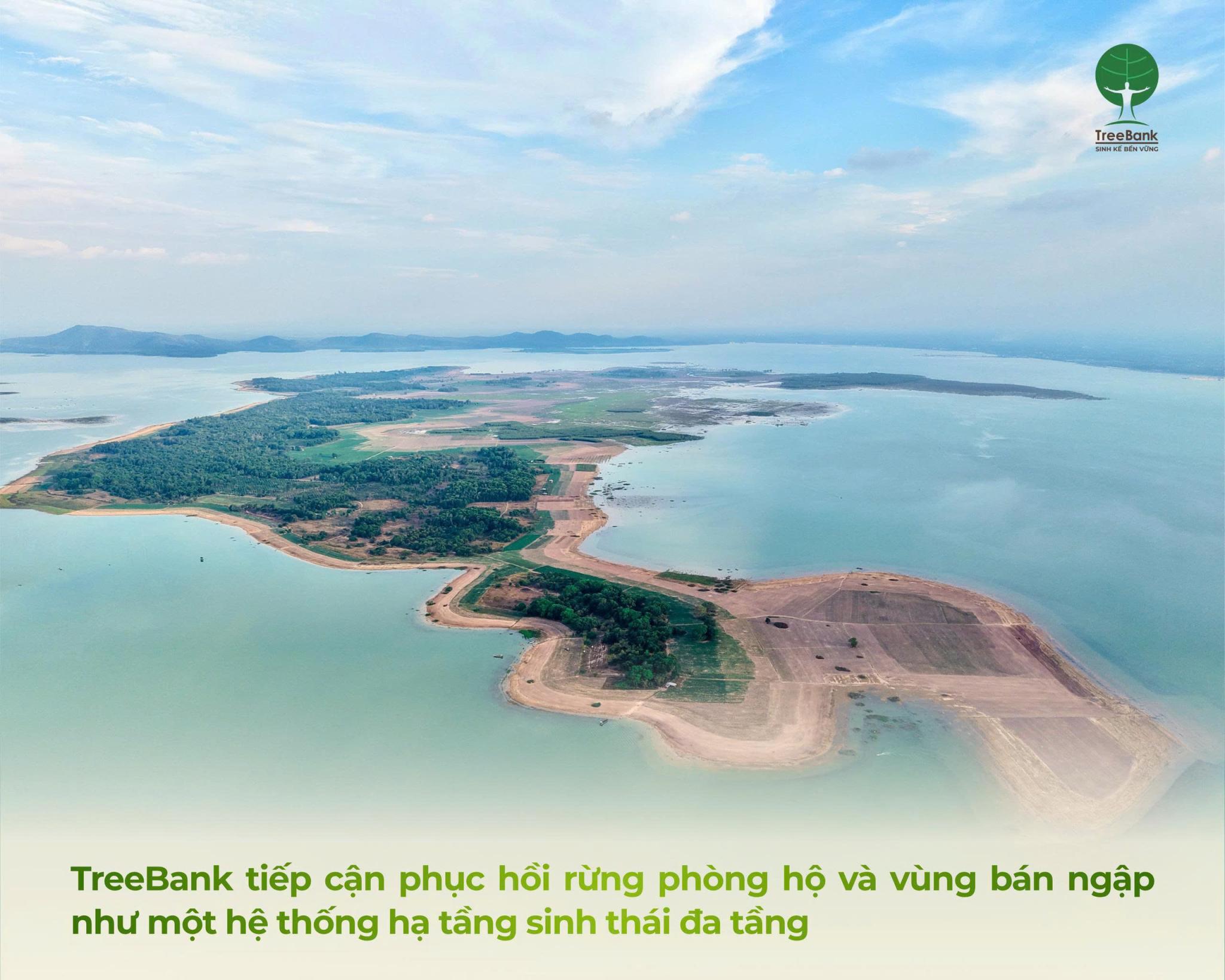
In 2 years of working at Dau Tieng Lake, TreeBank's approach does not start from scale but from understanding the right system. We survey the basin according to flow and erosion characteristics, identifying areas that have a major impact on sediment and nutrition. The team conducted experimental planting in lakeside and semi-submerged areas instead of focusing on dry soil, and closely monitored its adaptation to the water cycle.
Field observations show that a consistent trend is that areas with vegetation will help reduce turbidity and mud accumulation after rain. Meanwhile, the vacant area increases the flow of spills and suspended materials. This reinforces the original assumption that impacts on water must start from ecosystem structure and not from mere engineering.
THE ROLE OF ENTERPRISES IN THE BASIN SYSTEM
In value chain analysis, water is often seen as an input outside the system of a business. However, if you look at the basin approach, water quality is the result of variables including carpet cover, runoff, sediment, and nutrients. These variables are outside the factory fence but are in the economic system that determines profits.
This fact creates a gap in governance when the business bears costs at the end of the chain but does not control the variables at the end of the chain. These costs and risks include:
From a risk management perspective, end-chain interventions are often costly and passive. Conversely, intervention in the watershed will provide greater prevention. Therefore, the role of businesses is not only to solve environmental problems but to participate in adjusting input variables that directly affect operating costs.
COST REALLOCATION: FROM TREATMENT TO PREVENTION
One of the less discussed points is the location of costs in the water system. Currently, most of the resources are concentrated downstream for chemical treatment, energy for filtration systems and machine maintenance. Meanwhile, studies on watershed management from FAO and IUCN point to a more effective approach:
This leads to a new way of looking at ecosystem restoration without adding costs to businesses. On the contrary, we are reallocating and shifting the location of costs to optimize investment efficiency and protect input resources in a sustainable way.
Dau Tieng Lake is declining in efficiency because the water retention system is weakening. In that system, forests are not an add-on but a core part of the infrastructure. TreeBank approaches protection forest and semi-floodplain restoration as a multi-tiered ecological infrastructure system where water impacts can be monitored and analyzed based on field data.
If YOU are interested in this approach from the perspective of water stewardship or sustainability strategies, we are happy to discuss them further.